CURRENT ELECTRICITY
Ans. Kirchhoff's First law:At any junction the sum of the currents entering the junction is equal to the sum of currents leaving the junction
$$\:\Sigma i\:=\:0$$
Kirchhoff's second law: The algebraic sum of potential difference around any closed loop is zero.
$$\Sigma V\:=\:0$$
Wheatstone bridge:-As shown in the figure $R_{1},R_{2},R_{3},R_{4}$, are resistors connected in the Wheatstone bridge circuit in the form of quadrilateral. Along one diagonal battery is connected, along the other diagonal galvanometer is connected.
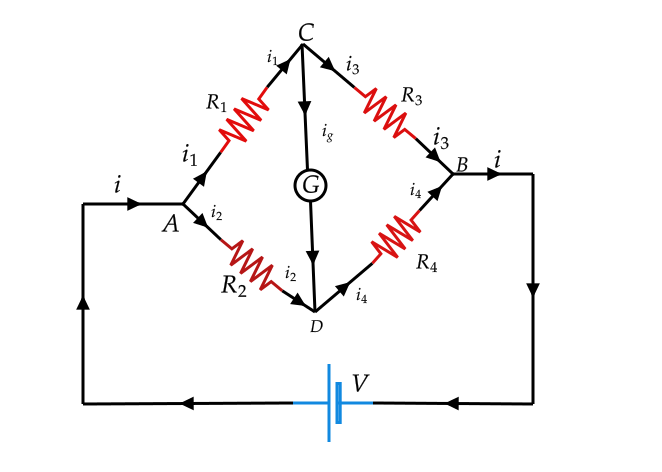
According to Kirchhoff's First law at junctions A, B
$$\begin{array}\\{i=i_{1}+i_{2}}\\{i=i_{3}+i_{4}}\\\end{array}$$
And at junctions C, D respectively
$$\begin{array} {cc} i_{1}=i_g+i_3 \\ i_4=i_g+i_2 \end{array}$$
According to Kirchhoff's Second law in loops 'ADGCA' and 'BCGDB', potentia differences respectively
$$\begin{array} -\:i_{1}R_{1}-i_{g}G\:+\:i_{2}R_{2}=\:0\\-\:i_{3}R_{3}+i_{g}G\:+\:i_{4}R_{4}=\:0\end{array}$$
When bridge is balanced $i_{g}=0$ from the above equations.
$$\frac{R_1}{R_2}=\frac{R_3}{R_4}$$
Therefore, the ratio of resistance of the adjacent side will always be equal.
Ans. Principle of potentiometer:- The potential difference across any portion of the wire is directly proportional to the length of that portion.
$$V= {\Phi l}$$
Comparing emf's of two cells using potentiometer: Consider two cells connected to potentiometer as shown in the circuit diagram and cells e.m.f are $E_{1},E_{2}$ ·
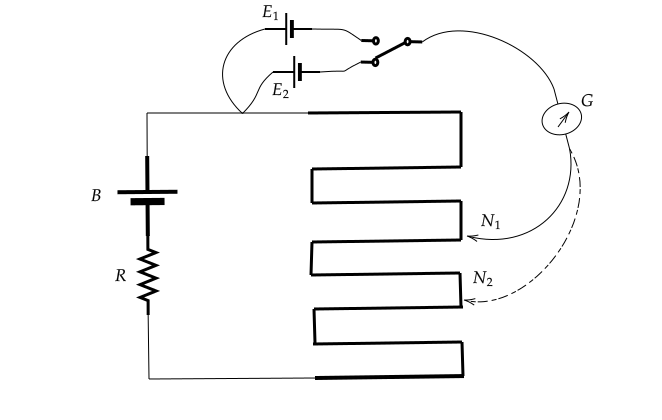
According to kirchhoff's second law
$$\begin{array}{c}-\:E_1\:+\:0\:+\:\Phi\:l_1\:=\:0\\-\:E_2\:+\:0\:+\:\Phi\:l_2\:=\:0\end{array}$$
From the above equations $$\frac{E_{1}}{E_{2}}=\frac{l_{1}}{l_{2}}$$
Ans. Principle of potentiometer:- The potential difference across any portion of. the wire is directly proportional to the length of that portion..
$$V={\Phi l}$$
Determination of Internal resistance of a cell using potentiometer: Consider a cell and high resistance connected to potentiometer as shown in the circuit diagram and cell e.m.f. is E, when resistance is connected to circuit, voltage is 'V' therefore,
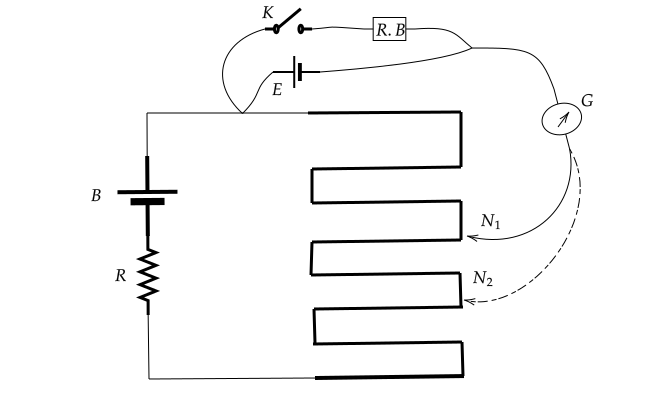
according to kirchhoff's second law
$$\begin{array}{cc}
&-\:E\:+\:0\:+\:\phi\:l_{1}\:=\:0 \\
& -\:V\:+\:0\:+\:\phi\:l_{2}\:=\:0
\end{array}\\$$
From the above equations $$\frac{E}{V}=\frac{l_{1}}{l_{2}}\quad-----(1)$$
But, $E$ = $i( r$ + $R)$ and $V=iR$
From eq (1) $$\left(\frac{r+R}{R}\right)=\frac{l_{1}}{l_{2}}$$
Therefore internal resistance of a cell $$r=R\left(\frac{l_{1}}{l_{2}}-1\right)$$