ELECTRIC CHANGES AND FIELDS
Total charge on a body is always an integer multiple of charge on electron
i.e , charge on a body is $Q=\pm ne$
Attraction can occur between two charged bodies or a charged body and a neutral body. But repulsion can occur only between two like charges only. Hence it is a sure test of charging.
Ans. $e=1.6\times10^{-19}\,C\,\,and \,charge \,q=1\,C$
$\therefore number\,of\, elctors\, \,n=\frac{q}{e}$
$n=\frac{1}{1.6\times10^{-19}}$
$n=6.25\times10^{18}$
Ans. Positive charge is required due to loss of electrons. Hence when a body is positively charged, its weight is decreases.
Force between two charges.$F\propto \frac{1}{r^{2}} \,\, (or) \frac{F_{1}}{F_{2}}=\frac{r_{2}^{2}}{r_{1}^{2}}$
a) Force increases by four times$\,\,\therefore F_{2}=4F$
b) Force decreases by four times $\,\,\therefore F_{2}=\frac{F}{4}$
Ans. If the electric lines of force intersect, then at the point of intersection, electric field will have two directions, which is not possible. Hence, they do not intersect.
Charge is a scalar. Hence sum of two equal and opposite charges is zero.
But field intensity is avector. At a point equidistant from given charges, field intensities may be equal in magnitude, but act in different directions. Their vector sum may not be zero.
Electrostatic field lines do not form closed loops if they closed loops then the work done in moving a charge along a closed will not be zero. These two statements indicate that the electric force is conservative.
Gauss law: The total electrical flux through a closed surface is equal to $\frac{1}{\epsilon_{\circ}}$ times the total charge(q) enclosed by the surface.
$\therefore electric\, flux\,\: \phi=\frac{q}{\epsilon_{\circ}}$
For a closed surface, the inward flux is negative, and outward flux is positive.
Electric intensity due to an infinite long charged wire at a radial distance r from it is
$ E=\frac{\lambda}{2\pi\epsilon_{\circ}r} $
Ans. Electric intensity due to an infinite plane sheet of charge is $ E=\frac{\sigma}{2\epsilon_{\circ}} $
Outside the shell, at a distance $r$ from the center, electric intensity $ E=\frac{1}{4\pi\epsilon_{\circ}}\,\frac{q}{r^{2}} $
Inside the shell, electric intensity $E=0$
Ans. A dipole of dipole moment $\vec{P}$ in a uniform electric field$\vec{E}$. A force $qE$ on $+q$ and a force $ -qE$ is $-q$ charge.
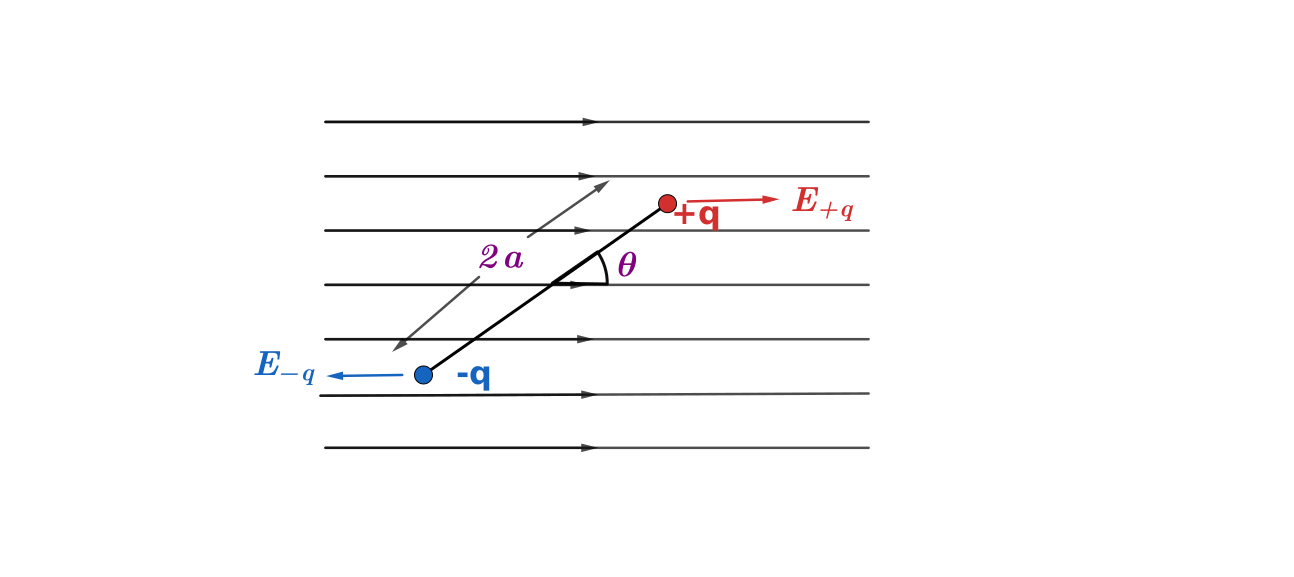
The forces actat different points, resulting in a torque on the dipole.
Magnitude of torque = magnitude of each force X perpendicular distance between two forces$$\begin{aligned}\\&\tau=q\mathrm{E}\times2\mathrm{a\sin\theta}\\&\tau=2\mathrm{qa}\: \mathrm{E}\mathrm{\sin\theta}\\&\tau=\mathrm{P}\: \mathrm{E}\:\mathrm{\sin\theta}\\&\vec{\tau}=\vec{\mathrm{P}}\times\vec{\mathrm{E}}\quad(\because\vec{\mathrm{P}}=2\mathrm{qa})\end{aligned}$$
Ans. Statement: The force between two point charges varied inversely as the square of the distance between the charges and directly proportional to the product of magnitude of the two charges and acted along the line joining the two charges
Explanation: Let $q_{1}\&q_{2}$ are two point charges and separated by a distance $r$ in vacuum $$\begin{array}{c}{\mathrm{F\propto q_{1}q_{2}}}\\{\mathrm{F\propto\frac{1}{r^{2}}}}\\{\mathrm{F\propto\frac{q_{1}q_{2}}{r^{2}}}}\\ {\mathrm{F=\frac{1}{4\pi\varepsilon_{\circ}}\frac{q_{1}q_{2}}{r^{2}}}} \end{array}$$Where $\varepsilon_{\circ}$-Permitivity of free space.
Ans. Let the point P be at distance $r$ from the centre of the dipole on the side of the charge $q$, as shown in figure.
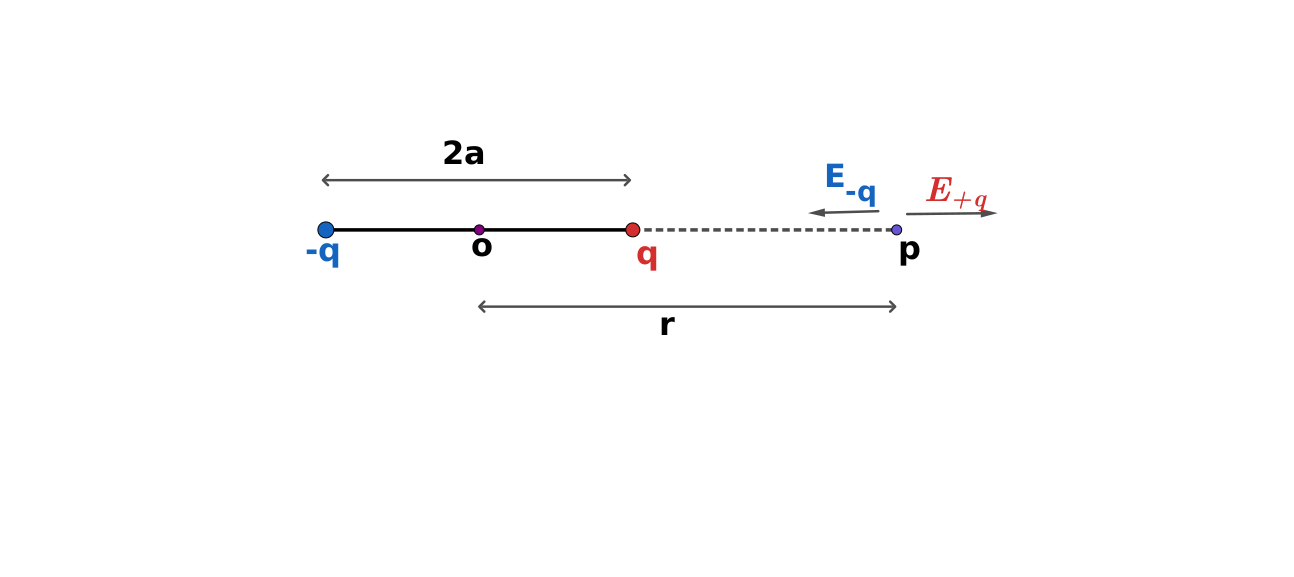 Then $$\mathbf{E}_{_{-q}}=-\: \frac{1}{4\pi\varepsilon_{0}} \frac{q}{(r+a)^{2}}$$$$\mathbf{E}_{+q}=\: \frac{1}{4\pi\varepsilon_{0}} \frac{q}{(r-a)^{2}} $$The total fleld at P is $$\mathbf{E}=\mathbf{E}_{+q}+\mathbf{E}_{-q}=\frac{q}{4\:\pi\:\varepsilon_{0}}\biggl[\frac{1}{(r-a)^{2}}\:-\:\frac{1}{(r+a)^{2}}\biggr]$$$$=\:\frac{q}{4\:\pi\:\varepsilon_{o}}\:\frac{4\:a\:r}{(\:r^{2}-a^{2})^{2}} $$For $r>>a$ $$\mathbf{E}=\frac{4\:q\:a}{4\pi\varepsilon_{0}r^{3}}$$$$\mathbf{E}=\frac{2P}{4\pi\varepsilon_{0} r^{3}}$$$$\text{Vector form}\:\: \mathbf{\vec{E}}=\frac{2P}{4\pi\varepsilon_{0} r^{3}}\hat{\mathbf{p}}$$
Ans. Let the point $P$ be at distance $r$ from the centre of the dipole $O$ as shown in figure.
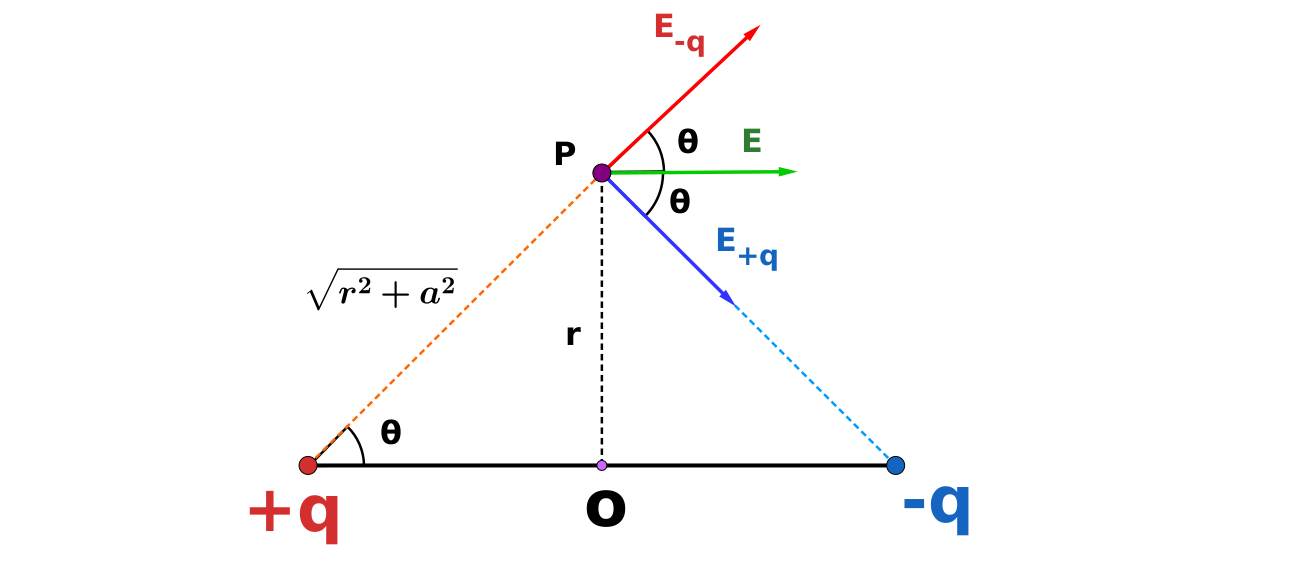 Then $$\mathbf{E}_{_{+q}}=\mathbf{E}_{_{-q}}=\frac{1}{4\pi\varepsilon_{0}}\:\frac{q}{(r^{2}+a^{2})}$$ The total fleld at P is $$\mathbf{E}=-(\mathbf{E}_{+q}+\mathbf{E}_{-q})\cos\theta$$$$\mathbf{E}=\frac{-2q}{4\:\pi\:\varepsilon_{0}}\biggl[\:\frac{1}{(r^{2}+a^{2})}\biggr]\cos\theta$$where $\cos\theta=\biggl[\:\frac{a}{\sqrt{(r^{2}+a^{2})} }\biggr]$ $$\mathbf{E}=\frac{-2q}{4\:\pi\:\varepsilon_{0}}\biggl[\:\frac{1}{(r^{2}+a^{2})}\biggr]\biggl[\:\frac{a}{\sqrt{(r^{2}+a^{2})} }\biggr]$$$$\mathbf{E}=\frac{-2q}{4\:\pi\:\varepsilon_{0}}\biggl[\:\frac{a}{(r^{2}+a^{2})^{3/2}}\biggr] $$For $r>>a$ $$\mathbf{E}=\frac{-2\:q\:a}{4\pi\varepsilon_{0}r^{3}}$$$$\mathbf{E}=\frac{-P}{4\pi\varepsilon_{0} r^{3}}$$$$\text{Vector form}\:\: \mathbf{\vec{E}}=\frac{-P}{4\pi\varepsilon_{0} r^{3}}\hat{\mathbf{p}}$$
Ans. Statement: The total electrical flux through a closed surface is equal to $\frac{1}{\varepsilon_{\circ}}$ times the total charge enclosed by the surface $${\phi_{_E}=\oint\overline{E}.\overline{ds}=\frac{1}{\varepsilon_{\circ}}q}$$
Importance:
1. Valid for any closed surface of any shape and size.
2. Applicable to any distribution of charges within the closed surface.
3. It is useful towards a much easier calculation of electrostatic field when the system has symmetry.