ELECTRIC POTENTIAL AND CAPACITANCE
Yes. Inside a charged shell, potential is non-zero but electric intensity is zero.
Yes, at the mid-point of a dipole, electric intensity in non-zero but potential is zero.
Ans. A surface, which has same value of potential at every point, is called an equipotential surface.
If it is not so, a component of field acts along the surface, hence work done to move a charge on that equi-potential surface is not zero. This is against the definition of equi-pointential surface.
Ans. If plate area A is doubled, the capacitance also get doubled
$q_{1}\,:q_{2}\,:q_{3}=1\,:2\,:3$
$V_{1}\,:V_{2}\,:V_{3}=1\,:1\,:1$
Ans. In parallel combination
$q_{1}\,:q_{2}\,:q_{3}=1\,:2\,:3$
$V_{1}\,:V_{2}\,:V_{3}=1\,:1\,:1$
Ans. In series combination
$q_{1}\,:q_{2}\,:q_{3}=1\,:1\,:1$
$V_{1}\,:V_{2}\,:V_{3}=1\,:2\,:3$
Ans. $C=\frac{A\varepsilon_{\circ}}{d}$
$therefore\:\: \frac{C_{2}}{C_{1}}=\frac{A_{2}}{A_{1}}$
$where \:\: A_{2}=2A_{2}$
$\therefore\:\: \frac{C_{2}}{C_{1}}=\frac{2A_{1}}{A_{1}}$
$ \:\: \frac{C_{2}}{C_{1}=2$
$\therefore$ capacitance also get doubled.
a plate separation of 1cm can you charge the capacitor to$3\times10^{6 }$ V?
Ans. No. distance between plates, $d = 1\:cm \:\:= 1\times10^{-2 }$\:\:m
Potential difference between the plates, $V= 3\times10^{6 }$ V
∴Electric field between plates
$E= V/d=\frac{ 3\times10^{6 }} {1\times10^{-2 }} = 3\times10^{8 }$ V/m
This is more than the dielectric strength of air $= 3\times10^{8 }$ V/m. so it is no possible.
Ans. 
Consider a point charge $+q$ at the origin as shown in the figure. Work done for $dx$ is $dW$.$$\therefore dW=-Fdx\cos\theta$$$$dW=-Fdx\quad ( \because \cos\theta =1)$$
The total work done in bringing a test positive charge $q_{\circ}$ from infinity to the point $P$ $$W=-\:\int_{\infty}^{r} \frac{1}{4\pi\varepsilon_{\circ}}\frac{qq_{\circ}}{x^{2}}dx$$$$W=-\:\frac{1}{4\pi\varepsilon_{\circ}}\int_{\infty}^{r} \frac{1}{x^{2}}dx$$ $$W=-\:\frac{qq_{\circ}}{4\pi\varepsilon_{\circ}} \left [ \frac{-1}{x} \right ]_{\infty}^{r} $$$$W=-\:\frac{qq_{\circ}}{4\pi\varepsilon_{\circ}} \left [ \frac{-1}{r} +\frac{-1}{\infty} \right ] $$$$W= \frac{1}{4\pi\varepsilon_{\circ}} \frac{qq_{\circ}}{r} $$$$\frac{W}{q_{\circ}}= \frac{1}{4\pi\varepsilon_{\circ}} \frac{q}{r} $$$$\therefore \text{Potential}\:\: V = \frac{1}{4\pi\varepsilon_{\circ}} \frac{q}{r} $$
Ans. 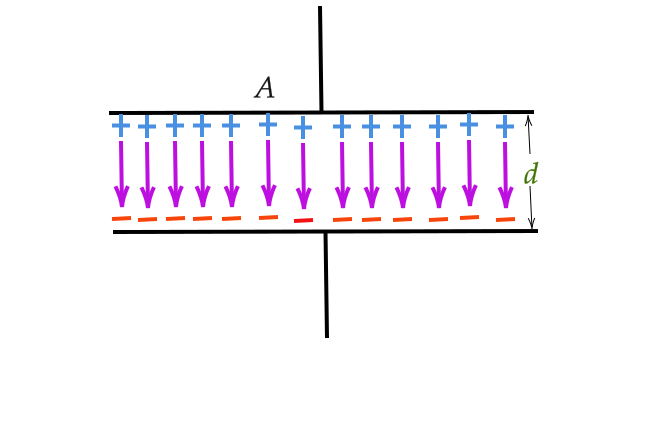
$A$ is a area of each plate, $d$ is separation between the two parallel plates. $q$ and $–q$ are charges on each plate surface charged density on $\sigma=\frac{q}{A}$.In the inner region between the plates, the electric flelds due to the two charged plates$$E=\frac{\sigma}{2\varepsilon_0}+\frac{\sigma}{2\varepsilon_0}=\frac{\sigma}{\varepsilon_0}=\frac{q}{\varepsilon_0A}$$parallel plates in capacitor behave like equipotential surfaces.
$\therefore $Potential $V=Ed$ $$V=\frac{q}{\varepsilon_0A}d$$$$\frac{V}{q}=\frac{q}{\varepsilon_0A}$$$$ \frac{1}{C}=\frac{d}{\varepsilon_0A}$$$$ C=\frac{\varepsilon_0A}{d}$$The above equation represents capacitance of a parallel plate capacitor.
Ans. Series combination: In series combination first capacitor second plate is connected to second capacitor first plate and second capacitor second plate is connected to third capacitor first plate and so on first capacitor first plate and last capacitor second plate is connected to opposite terminals of a battery.
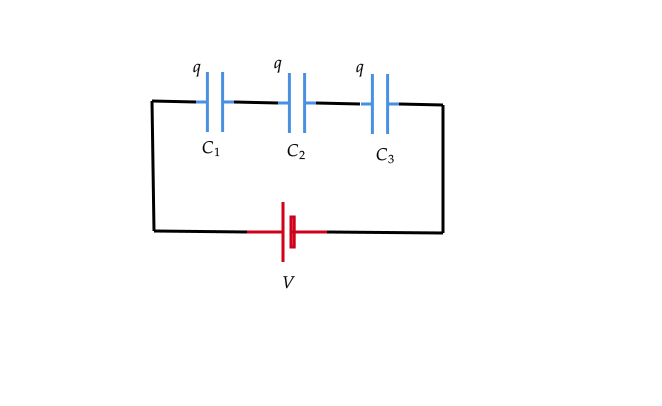
Three capacitors of capacities $C_1, C_2$ and $C_3$ are connected in series combination as shown in the figure.In series combination the charge on each capacitor will be same but potential is different. $V_1=\frac{q}{C_1},V_2=\frac{q}{C_2},V_3=\frac{q}{C_3} $and $ V=\frac{q}{C}$
Total potential difference across the series combination is $$V = V_1 + V_2 + V_3$$ $$\frac{q}{C}=\frac{q}{C_1}+\frac{q}{C_2}+\frac{q}{C_3} $$$$\frac{1}{C}=\frac{1}{C_1}+\frac{1}{C_2}+\frac{1}{C_3} $$
The above equation represents equivalent capacitance in series combination
Ans. Parallel combination: If the first plates of all the capacitors connected to common terminal and second plates of all the capacitors connected to common
terminal and these terminals are connected to oppositeterminals of the battery
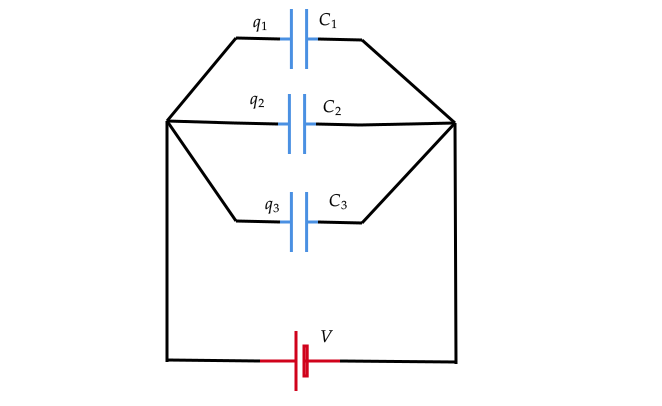
Three capacitors of capacities $C_1, C_2$ and $C_3$ are connected in parallel combination as shown in the figure.In parallel combination the potential on each capacitor will be same but charge is different.
$q_1={V}{C_1},q_2= {V}{C_2},q_3= {V}{C_3} $and $ Q={V}{C}$.
Total charge in the parallel combination is $$Q = q_1 + q_2 + q_3$$ $${V}{C}={V}{C_1}+{V}{C_2}+ {V}{C_3} $$$$ {C}= {C_1}+ {C_2}+ {C_3} $$
The above equation represents equivalent capacitance in parallel combination