THERMAL PROPERTIES OF MATTER
| Heat | Temperature |
|
|
Ans. Yes, the coefficient of expansion α, β and γ are not same in Celsius and in Fahrenheit scale.
Because, 1°C = 1.8°F
Ans. Yes, cast iron, rubber, and pure water (between 0°C to 4°C )
Ans. The gaps are left in between two successive rails to allow the free expansion of the rails during the summer season. (or) To allow the linear expansion of rails during summer.
Ans. Liquid have no shape and size of their own. They take shape of the vessel. Hence, they does not have coefficients of linear and areal expansion.
Ans. The amount of heat energy required to convert a unit mass of the solid substance into
liquid substance at 0°C is known as latent heat of fusion.
Ans. The amount of heat energy required to convert a unit mass of liquid substance in to vapour at 100°C is known as latent heat of vaporization.
(or) Heat required to convert liquid into vapour.
Ans. Black bodies are good absorbers. So, a black coated utensils will absorb more heat. Lower portion of the utensils is in contact with fire. Copper is a good conductor of that, so copper is used at the bottom of cooking utensils.
Ans. The wave length ( λm) of maximum intensity of emission of black body radiation is inversely proportional to absolute temperature (T) of the black body
i.e. λmT = b(constant)
Ans. Density of hot air is less. So in a room hot air goes to top layers i,e nearer to the roof. Hence to escape the hot air from the room ventilators are provided just below the roof.
- No, the body does not radiate heat at 0°k.
- Yes, the body radiates heat at 0°C
- Different modes of transmission of heat are i) conduction ii) convection iii) radiation.
- Conduction and convection require medium
Ans. Coefficient of thermal conductivity: It is defined as the quantity of heat conducted per second per unit area of cross section per unit temperature gradient.
Temperature gradient: The change in temperature per unit distance moved in the directionof heat flow is called temperature gradient.
Ans. Emissivity: It is defined as the ratio of the emissive power of the body to that of black body at the same temperature.
Ans. Greenhouse effect: Temperature of the earth increases due to the radiation emitted by the earth is trapped by atmospheric gases like Co2, CH4, N20, CFC etc. is called greenhouse effect.
Global warming: Due to human activities concentration of greenhouse gases enhanced and the Earth become warmer. This effect is called as Global warming. Because of Global warming ice caps are melting faster, sea level is rising and weather pattern is changing
Ans. Absorptive power: At a given temperature and wavelength range, the ratio between the
radiant energy absorbed by the body and the energy incident on the body, is known as
absorptive power.
∴The absorptive power of a perfect black body = 1
Ans. Newton’s law of cooling: The rate of loss of heat of the body is directly proportional to the difference of temperature of the body (T2) and the surroundings(T1).
- The law holds good only for small difference of temperature.
- Loss of heat is negligible by conduction and only when it is due to convection.
- Temperature of the body is uniformly distributed over it.
Ans. The roof of buildings are painted white during summer because white is a good reflector and poor absorber of heat. Hence in summer we feel cool in house.
Ans. Celsius scale of temperature: In this scale of temperature the freezing point of water is taken as lower fixed point $0°C$ and boiling point of water is taken as upper fixed point $100°C$ at atmospheric pressure. The interval between these two fixed points is divided into $100$ equal parts and each part is called $1℃$.
Fahrenheit scale of temperature : In this scale of temperature the freezing point of water is taken as lower fixed point $32°F$ and boiling point of water is taken as upper fixed point $212°F$ at atmospheric pressure. The interval between these two fixed points is divided into $180$ equal parts and each part is called $1°F$.
Relation between Celsius and Fahrenheit Scales. $$\begin{array}{}{\frac{ C-0}{100-0}=\frac{ F-32}{212-32}}\\ {\frac{ C}{100}=\frac{ F-32}{180}}\\ { C=\frac{5}{9}( F-32)} \end{array}$$
Ans. It bends copper on convex side. Because, the coefficient of linear expansion of copper is greater than that of iron. Therefore, when bimetallic strip made of copper and iron is heated, copper strip expands more than the iron strip.
Ans. The time period of a pendulum clock $T= 2\pi \sqrt{{l}\over {g}}$
i) In winter, due to decrease in temperature, the length of the pendulum decreases. Thus time period decreases and therefore the pendulum clock gains time or go fast.
ii) In summer, due to increase in temperature the length of the pendulum increases. Thus the time period increases and therefore the pendulum clock looses time or goes slow.
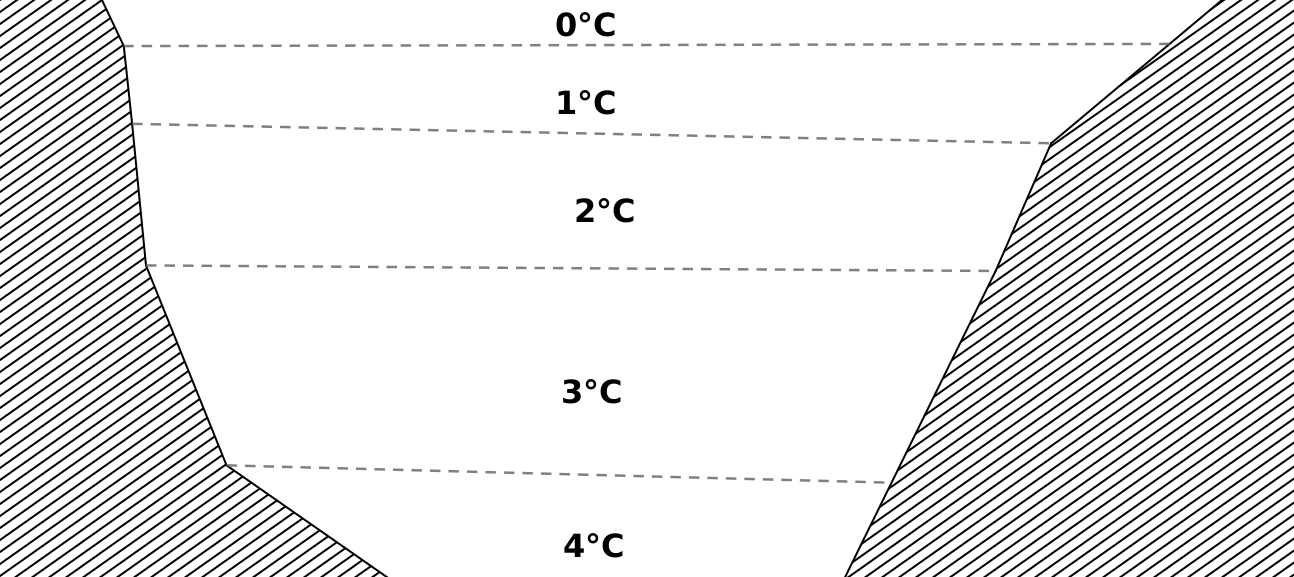
Ans. The maximum density of water at $4°C$ . Hence , when temperature increase from $0°C$ to $4°C$ water contract instead of expansion. Thus, as atmospheric temperature decreases, the upper layers of the lakes cool, contract and sink to the bottom. This goes on until the whole of the water reaches the temperature of $4°C$. When the top layers cool further temperature falls below$ 4°C$ it expands and becomes lighter. It does not sink down wards and remains at the top with further cooling the top layer gradually from ice at the top. Ice and water are bad conductors of heat.This results in water remaining at the bottom at $4°C$. So that aquatic animals survive in those layers of water.
Ans. Conduction: Conduction is the process in which heat is transmitted from one part of the body to the other without the actual movement of the particles.
Ex: Heat transfer takes place from the hot end of the rod to the other end by conduction
Convention: It is the process in which heat is transferred from one point to another by the actual movement of the heated material particles.
Ex: Land and sea breezes and trade winds are due to convection.
Radiation: It is the process in which heat is transmitted from one place to another without any material medium.
Ex: Heat reaches the earth from the sun by the process of radiation. Heat radiations can pass through vacuum.